
Should we forget exercise for weight loss and use diet only!
The Daily Mail reported a story on 13th September 2011 entitled ‘The government should stop promoting exercise as a weight loss measure...and we should just eat less’ as a result of a statement recently made by Lord McColl of Dulwich. We felt this bold stance need some comment on our part as diet and exercise play such a critical role in weight management.

It is so important to get across the correct message to the general public with regards to obesity, overweight and public health and it is clear that Lord McColl’s intention was to do just that. We would like to add our support to his general message that diet is the most important aspect for tackling obesity. Dietary management has been shown to have considerably higher levels of success, in relation to losing total body weight and body fat, than typical low to moderate exercise has ever been proven to do. However, we do contest Lord McColl’s oversimplification of the dietary strategy that is best for weight loss is a straightforward reduction in calories. The UK national dietary surveys performed in 1987, 2001 and 2009 have clearly shown that the nation’s calorie intake has been on a steady decline during the same period that obesity rates have doubled. Average male calorie intakes have dropped from 2468 kcals in 1987 to 2255 kcals by 2009. Female calorie intakes have always averaged less than 1700 kcals but had also dropped 40 kcals to 1645 kcals by 2009. Despite these lower energy intakes as an average population obesity has continued to increase, suggesting that the cause of obesity is a much more complex problem than managing a simple energy balance equation.
For years I have typically seen the exercise enthusiasts jump in at this junction and proudly point out that these statistics clearly suggest it is our lazy, sedentary lifestyles that have led to increasing obesity despite the decrease in calories ingested. However, if we dig a little further into the exercise and activity factor we find that the Health Survey for England does not show this 'obvious' reduction in activity. National activity rates have been measured regularly since 1997 and this data shows that in both males and females the reported rate of health related activity has consistently increased in every age category below 75 years old. The percentage of females achieving the minimum activity advice has risen from 21% in 1997 to 27% in 2006 during which time female obesity rose from 19-24%. Male activity rates also rose from 32% in 1997 to 40% in 2006 during which time male obesity rates increased from 16-23%. This leaves us in somewhat of a dilemma! To stress the point - national data shows that calorie intakes have decreased and health related activity rates have increased during a significant period of rising obesity levels. This does not support the energy balance hypothesis we have so desperately clung onto as our magic answer to obesity. Once again it must be stated that obesity is a more complex problem than simply trying to create a negative energy deficit using diet and exercise.
The Daily Mail article took great lengths to point out the health benefits of exercise for many different conditions such as diabetes, heart disease, cancer, osteoporosis, stroke, depression and arthritis. We certainly do not dispute that exercise can have these benefits and it is highly likely that Lord McColl being a very experienced surgeon and an emeritus professor would be happy to agree with and support these concepts. However, he did not state at any point in the article that exercise was not beneficial for these ailments; he only said that exercise was less useful as an answer to weight loss. It seems unusual to use evidence in favour of exercise that is not related to the concept being challenged - i.e. that exercise is not a great solution for weight loss. What are the Daily Mail trying to point out with this? Indeed when European health related activity rates are charted against the obesity rates in the same nations little correlation is evident, as seen below by the flat green trend line.
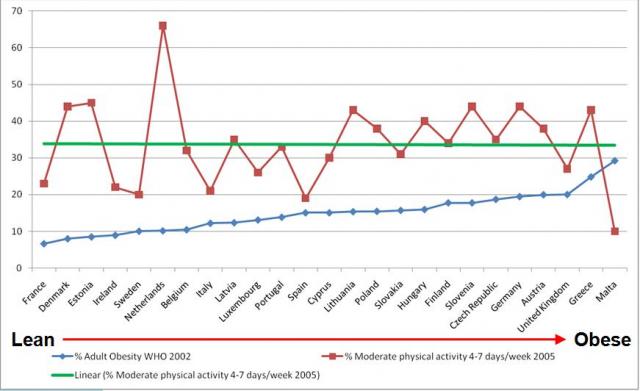
Interestingly France, the second leanest nation in Europe, also has a high average calorie intake (over 3500 kcals), a high fat intake (170g) and has relatively low health related activity levels (only 23% population). Any honest investigation into the science behind low to moderate activity and its benefits for weight loss as a sole corrective strategy show that it is a poor solution as it achieves only minimal long term results. In a combined statement in 2007 the American College of Sports Medicine and the American heart Association said:
‘It is reasonable to assume that persons with relatively high daily energy expenditures would be less likely to gain weight over time, compared with those who have low energy expenditures. So far, data to support this hypothesis are not particularly compelling.’
Despite Lord McColl's opinion, exercise can still be a useful contributor in the weight management battle if it is prescribed correctly. But the real benefits for weight loss are certainly not found at the low to moderate intensity level. This lower intensity level is really for aiding in other cardiovascular health benefits, but has little impact upon obesity. Weight loss and exercise that optimises body fat burning requires the individual to build up their fitness and aerobic conditioning to be able to tolerate more intense bouts of exercise. This need not be for long periods of time with drawn out tedious, exercise monotony. 20-30 minutes of more vigorous activity 3-4 times per week has been shown to boost post exercise metabolic rate and as such increase the ability to burn body fat for many hours after an exercise session. Not only will more intense exercise burn more calories in the exercise session, but compared to moderate intensity exercise more vigorous work, as described above, has been scientifically shown to have 9 times the fat burning capacity in the post exercise period. The same increases in post exercise metabolism are simply not found following a low to moderate exercise session which fundamentally burns off too little energy and has little effect on metabolic rate to offer a viable solution for weight loss.
The primary solution for obesity management has to be a dietary solution, in particular a reduction in dietary carbohydrates for obese individuals who are showing clear signs of insulin resistance. Insulin resistance is a common symptom in the obese. Insulin, in a nutshell, is the number one fat storing hormone in the body and by managing plasma levels of insulin effectively the driving force that signals for fat to be stored into fat cells decreases.
Carbohydrate rich foods offer the strongest stimulus for insulin and as such their reduction should form a major part of a dietary strategy for obesity. It is interesting to note that whilst the national dietary surveys have shown that calorie intakes in the UK have declined the percentage of the calories we do eat from dietary carbohydrates has actually increased! Now before you even think about blaming fat intake too, dietary fat as a percentage of total calories within the diet have dropped in the UK from over 40% in 1987 to 35% by 2001 and 2009 - exactly in line with current dietary recommendations. This increase in carbohydrates would certainly play a big part in causing an increase in average blood insulin and as such offers an alternative explanation for rising obesity during a time of lower energy intake. In the last 10 years there has been a renewed interest in studying low carbohydrate diets within the scientific community, primarily because carbohydrates are more and more being targeted as the culprit in weight gain. The general consensus at this point is that low carbohydrate diets offer better results than typical low calorie, low fat diets in terms of total weight lost, maintenance of lower weight, control of blood sugar and blood insulin and in maintaining better cholesterol levels and improving other heart disease markers.

These are vital issues to understand in the efforts that are being made to tackle the obesity epidemic. Whilst all the efforts being made to reverse the rising tide of obesity are admirable, it is vital that the changes we are working so hard to instigate are actually going to have the desired effect of long term weight loss. Dietary and exercise change do form a major part of the battle, but that change is not going to be as effective if we keep focusing on low to moderate activity and decreasing calories. These theories have been tried and tried again and they continue to fail us. When will we wake up and let this weak and frail theory slip away for good. The emphasis for obese and overweight adults needs to change towards a low carbohydrate diet where insulin resistance and abdominal obesity is present. A complete removal of processed foods and other such junk will also help remove many of the carbohydrate ridden, offending foods. A shift to a natural, organic whole food diet with a greater emphasis on healthy fats and proteins with more moderate to low carbohydrate intakes will serve to bring about much better long term weight loss without the hunger pangs and intense cravings often experienced by low calorie and low fat dieters. Remember exercise can contribute well in this battle, but needs to be built gradually until regular bouts of shorter more intense exercise can be tolerated as this will boost post exercise metabolism and help to burn more body fat at rest between exercise sessions. What could be better than that!