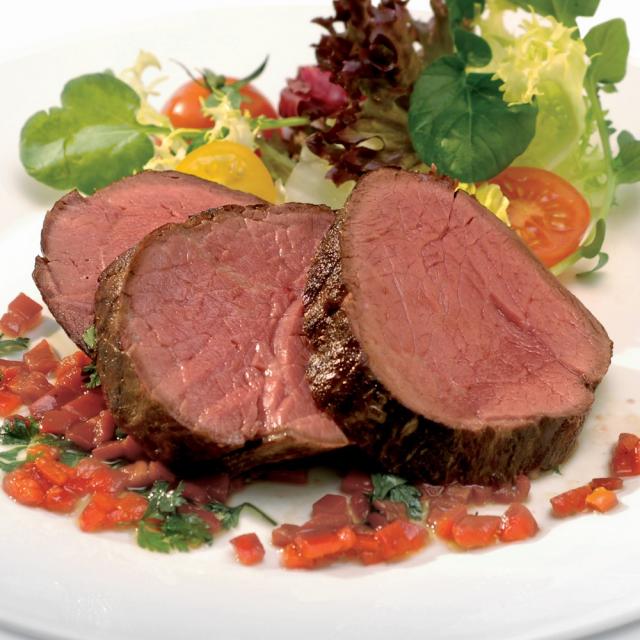
Upping your steaks!
Beef has long been demonized as a food that contributes to several modern chronic diseases such as heart disease, osteoporosis and colon cancer. The consumption of red meat has increased in general throughout the Western world, but an association of trends is not proof neither a convincing reason to pin the blame solely on beef for the observed rising disease rates. Indeed many aspects of life have changed over the last 5 or 6 decades. In the US beef consumption increased 46% to 36kgs per person per year between 1909 and 2000. This increase occurred during a time when many of the modern chronic diseases such as heart disease also increased. However, numerous other foods have also had dramatic increases in consumption during the same period; for example, poultry increased 280% to 32kgs per person per year and vegetable oils 437% to 27kgs per person per year by the year 2000. Despite these significant increases there is little apparent expert advice or demand for a reduction in poultry or vegetable oil intake. In the UK poultry consumption has more than doubled in the last 20-25 years whereas beef consumption has remained fairly static. The public choice has also shifted with regards to the cuts of meat commonly purchased towards options that provide more value for money such as beef mince (40% of beef sales) and beef roasting joints (29% of beef sales). Despite these concerns and changes beef sales in the UK are still fairly strong pulling in a significant £4.9 billion in 2001 (Mead, 2003).
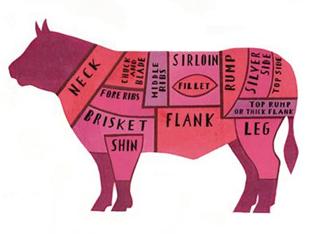
Beef is full of many nutrients necessary for health, including vitamin B12 which is needed for producing red blood cells and supporting the nervous sytem. It is also rich in carnitine and co-enzyme Q10 which have been shown to be beneficial for heart heath and in complementing traditional therapies in those who have already suffered with heart problems (Enig & Fallon, 2000).
The warnings about beef and its effects on heart health due to its high fat and cholesterol content have been pushed beyond the limits that science can truly support. Beef fat is composed of numerous different types of fat, it is not just saturated fat. In fact about half of the fats in beef tallow are unsaturated. For absolute clarity the typical fatty acid profile for beef is as follows:
- Saturated fats 49-54% (fatty acid ratios of 25% palmitic, 22% stearic & 3% myristic)
- Monounsaturated fats 42-48% (fatty acid ratios of 39% oleic & 3% palmitoleic)
- Polyunsaturated fats 3-4% (fatty acid ratios of 2% linoleic & 1% linolenic)
The two major saturated fatty acids in beef, stearic and palmitic are considered by some experts to be the preferred source of energy for the heart. These fatty acids do not go rancid easily like polyunsaturates; they do not initiate cancer and do not irritate the arterial walls (Enig & Fallon, 2000). Stearic acid has been found to improve HDL cholesterol, the 'good' cholesterol and has no effect on LDL, the supposed 'bad' cholesterol. The primary monounsaturated fatty acid in beef is oleic acid (39%), the very same type of fat that is found in abundance in olive oil which has been heralded for its capacity to reduce improve cholesterol levels and lower heart disease risk. The monounsaturate, palmitoleic acid, whilst only in small amounts in beef fat has intriguingly been found to have beneficial antimicrobial effects that help protect the gut against pathogens. It also helps to oxidise certain fatty acids and therefore may play a small role in protecting against weight gain. Beef fat that comes from grass fed animals will also contain reasonable amounts of a naturally occurring anti-carcinogenic trans fatty acid called conjugated linoleic acid or CLA. CLA has been found to help normalise body fat deposition and may also play a role to some extent in weight management. Therefore, it is clear that beef fat is not all bad, in fact the large majority of fatty acids are good as they provide benefits to human physiology and function.
There are many different cuts of beef that will have slightly different ratios of proteins and fat and some key nutrients. It is hard to recommend a specific cut for a specific purpose, but here is a table to compare the different cuts of steak. All amounts are displayed in levels per 100g of product.
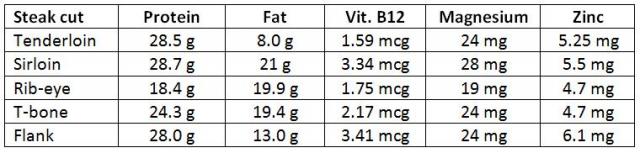
To help understand how these nutrient values compare to our daily needs the following represents the daily requirement of each of the above micronutrients:
- Vitamin B12 6 mcg
- Magnesium 400 mg
- Zinc 15 mg
It can be seen that most steaks are a good source of both vitamin B12 and zinc. Whilst steak is not a particularly good source of magnesium, the addition of some unprocessed, hand harvested sea salt during preparation will help to quickly remedy that as it is rich in magnesium. It is also clear that a steak is a very rich source of protein and as such will provide high levels of satiety and keep you feeling full and satisfied for long periods of time.
It would be wise to choose high quality sources of beef when shopping to ensure that the animals you eat are reared in appropriate conditions with good animal husbandry. Do not underestimate how important this is for the cows health and for yours. Nutrition can only be passed up the food chain to us, so we need to be sure the animals we eat are healthy and rich in nutrients. Locally produced, organic, grass finished steak would be a great choice if you can find it. This will ensure high levels of animal care, no pesticides or herbicides, no routine antibiotic use, longer growing time prior to slaughter, no grain feed or extruded concentrated pellets, all of which can negatively impact on the animals health and nutrient status.
All of this may seem just too fussy. Why not just choose any old steak? Well, all I can say is that it will all make sense and fall into place once you taste your first tender, juicy, melt in the mouth, perfectly cooked, organic, grass finished steak! In that pleasurable moment you will have your moment of clarity and will know why you don't just eat any old steak. On top of this the real beauty is that you can have peace of mind too knowing that this delicious food is contributing to your health and is not an indulgence that will slowly strangle your heart.