
Counting calories doesn't work!
I can imagine that many feel this is a very bold statement to make. I agree, it is. But yet I am confident in the truth of this statement in relation to much of the current scientific evidence. The general principle accepted by many as a method of losing or maintaining weight is that we MUST burn off more calories than we take in. Only then with this net loss of total calories will we see a reduction in body weight. This has been touted as the answer to the obesity crisis for many years. Yet despite this widely known answer there is clearly a continuing increase in the total amount of obesity which has risen at a steady rate of 3-4% every 5 years since national dietary guidelines were first introduced in the UK in 1983. Only 7% of the UK population was considered obese in 1983, whereas today 24% of the population is considered to have a BMI of over 30, the level set by the World Health Organisation as grade 1 obese.

So despite everyone accepting this fact that losing weight is simply a matter of eating less than we burn off the rate of obesity has more than tripled in the last 25 years. Does that mean that people just blatantly ignore such a simple guideline and gorge themselves into an overweight state? In my 14 years in the health and fitness industry I have never met a single person who wanted to be overweight. A huge US survey in 1999 of 107,804 people found that 71% of the population group were using dietary strategies to try and lower or maintain their weight. So it is obvious then that the majority of the population certainly grasp this basic idea that dietary intake can aid in weight loss, yet the US has greater levels of obesity than the UK at 33%. In both countries calorie deficit is the most common strategy used to achieve weight loss whether by total calorie restriction, fat restriction or increasing activity to burn off more calories.
Does this simply mean that we are becoming more sedentary and this is why we are gaining weight? Well in order to make such claims we surely need to back up this with hard data. the following is the US trends identified by the amount of leisure time that is spent involved in physical activity.
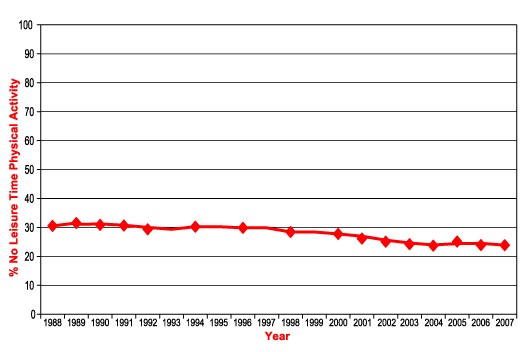
There is no doubt that there is a decreasing trend in time spent in physical activity, but does this marginal 6% reduction provide enough justification for a doubling in obesity in the US from 17 to 33% in obesity alone? I am far from convinced that this adequately explains the obesity trends! Therefore, neither dietary habits nor exercise trends provide enough evidence to support this simple hypothesis of creating a negative calorie deficit in order to lose weight.
So where did this idea come from then? Who created the theory that calories must be restricted in order to lose weight? The world of nutrition? Human physiology? Biology? None of these generated such an idea, it came from the domain of physics! We base this hypothesis on the 1st law of thermodynamics:
Energy in - Energy out = Total Energy
This is not exactly how this law is stated, but has been viewed like this for some time. We incorrectly assume that the total energy, our overall weight, is always the result of being too lazy and eating too much. Look again at the equation. Is there any indication that this equation only works from left to right? An equals sign only infers that the values on either side must be the same, it does not assume cause and effect. This means that too much food and not enough exercise may cause an increase in our weight, that is true. However, it also means that an increase in our weight may cause us to become more lazy and stimulate greater hunger and therefore more food intake. Think of anyone you know who is carrying too much weight. How would they describe their energy levels? In my experience the response is almost always that their energy is moderate to low, or they experience bouts of fatigue throughout their day. If they are fatigued it is highly unlikely that they will feel like doing anything active or exercised related. The result of forcing yourself to do such exercise will cause even greater fatigued. Whether you are fit or not fatigue is a deterrent to exercise! If you experience fatigue regularly it is even less likely that activity levels will be high.

Physics has gifted us this theory that nobody dares question. We blindly state that weight loss is all about calorie counting. Yet when we step back and go to the source of this theory it becomes clear that we have added an erroneus addition. We laid down that the food we eat combined with a lack of activity was the cause of obesity. Once we accept that this law allows increasing body fat levels to be the cause of decreasing activity levels and greater hunger and food intake we must accept that calorie counting may be completely barking up the wrong tree. If you followed this discussion easily you may now have another burning question in your mind. If it is not how much food we eat or how much activity we do, then what causes the body to become obese or overweight? Now there is the million dollar question? Perhaps if that was more widely known and understood we wouldn't have observed the tripling of obesity here in the UK that happened over the last 25 years. Perhaps it is the establishments pride that stops them from admitting they still don't have adequate answers to solve our bulging waistlines! Mother Nature does have those answers - eat the food that has naturally been grown or reared for generations to support human health. Stop processing the life force out of everything we eat.