Historical Christmas dinner
Christmas Turkey
Turkey's scientific name is Meleagris gallopava (mel-e-AY-gris-low-PAY-voe) from Latin gallus, meaning cock, and pavo, meaning chickenlike. Meleagris is the Roman name for guineafowl, suggestive of the early confusion of the turkey with guineafowl.
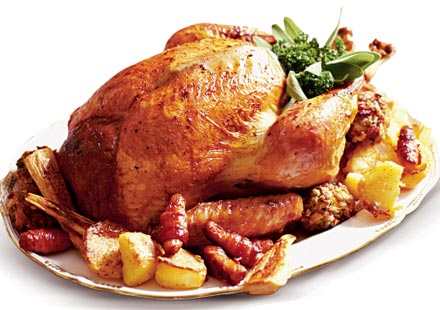
It is by no means clear how the turkey gained its name. One suggestion is to do with the wild turkey's call which sounds like 'turk-turk-turk'. Another likely explanation is that in the 16th century, merchants trading along the seaboards of the Mediterranean were known as Turkes. They probably included the birds in their merchandise and they became known as turkey fowls. Another theory is that Columbus thought the new world was connected to India and that turkeys were really peacocks, so he named them "Tuka" which is peacock in the Tamil language of India.
The American Indians hunted wild turkey for its sweet, juicy meat as early as 1000AD. Turkey feathers were used to stabilise arrows and adorn ceremonial dress, and the spurs on the legs of wild tom turkeys were used as projectiles on arrowheads.
Turkeys are believed to have first been brought to Britain in 1526 by Yorkshireman William Strickland - he acquired six birds from American Indian traders on his travels and sold them for tuppence each in Bristol. Henry VIII was the first English king to enjoy turkey, although Edward VII made eating turkey fashionable at Christmas. But most English households lacked ovens and utensils necessary for complicated dishes. Food preparation was achieved by slow boiling in pots hung over the hearth fire-the Christmas turkey or goose had to be carried to the baker's for roasting. With ovens becoming a common feature in the home, roast turkey could be cooked at home as part of the traditional festive meal.
For the best quality christmas fowl, why not try a locally produced organic, free range traditional wild turkey, or a similarly produced duck or goose.
See the Behind the label: turkey article recently published by the Ecologist to learn why most turkey consumed this Christmas may leave a bad taste in the mouth.
Mince pie
Mince pies are traditionally eaten during Christmas and New Years. The pies are typically very small, two to three inches in diameter, however the American version is usually four times larger, and able to serve many.
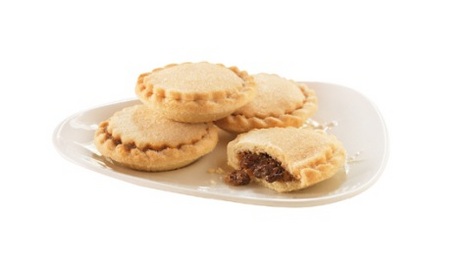
"Mince" comes from the word "mincemeat," which interestingly enough no longer contains meat. Mince pies evolved from a medieval pastry called "chewette." It was made with chopped meat or liver, boiled eggs, ginger, dried fruit and other sweet ingredients. It was fried or baked. During the 17th century, the meat products were reduced and more fat was added in the form of suet, from either beef or mutton fat. At some point during the 19th century throughout Great Britain and North America, mince pies developed to the point that they no longer contained any meat. The suet pies are still made today, but they usually vary from the traditional version.
Today mince pies are traditionally filled with fruit mincemeat, also known as fruitmince, containing dried fruit (raisins, currants, cherries, apricots, candied peels), spices (cinnamon or nutmeg), nuts (walnuts or almonds), suet and alcohol (brandy or rum). The pie is cooked and dusted with caster sugar or icing sugar.
Although some families still make homemade mince pies, they are readily available pre-madein most supermarkets. However, the modern factory made pies lack the traditional nutrition of both the meat based and fruit based traditional versions.
The best quality mince pies today will most certainly be homemade from fresh, organic butter/lard pastry and your own organic fresh and dried fruit and organic spices.
Eggnog
Eggnog, or a very similar drink, may have originated in East Anglia. The "nog" part of its name may stem from the word "noggin", a Middle English term used to describe a small, wooden, carved mug used to serve alcohol.
Yet another story is that the term derived from the name "egg-and-grog", a common Colonial term used to describe rum. Eventually the term was shortened to "egg'n'grog", then "eggnog".
The ingredients for the drink were expensive, so it was popular mainly among the aristocracy. In those days the average Londoner rarely saw a glass of milk as it was difficult to transport it in from the country and was expensive when it was brought in. Also there was no refrigeration, and the farms belonged to the big estates. Those who could get milk and eggs to make eggnog mixed it with brandy, Madeira or even sherry.
The drink crossed the Atlantic with the pioneers to the English colonies during the 18th century. Since brandy and wine were heavily taxed, rum from the Caribbean was a cost-effective substitute. The inexpensive liquor, coupled with plentiful farm and dairy products, helped the drink become very popular in America.
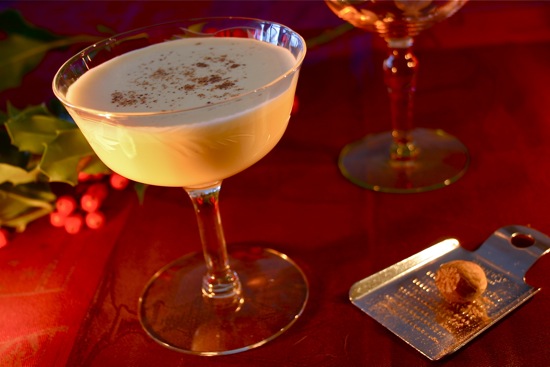
Traditional eggnog typically consists of milk, sugar, spices, and raw eggs. Frequently, cream is substituted for some portion of the milk to make a richer drink. Toppings may include vanilla ice cream, whipped cream and a wide variety of garnishes, notably grated nutmeg and chocolate curls. Since the 1960s, eggnog has often been served cold and without spirits, both of which are significant departures from its historical origins.
The best quality eggnog can be made from raw jersey milk, free range organic egg yolks, beaten egg whites, organic nutmeg and a good helping of raw double cream. Mmmmm!