Email to Food Standards Agency - Raw milk Vs Pasteurised milk
The following are letters between myself and Ifzal Khan a dairy hygiene specialist for the FSA.
Dear Ifzal,
I would like to take a moment to highlight research in favour of raw milk
as a nutritionally superior product to pasteurised milk. I understand the
fear of harmful pathogens present in milk and why pasteurisation destroys
those pathogens supposedly making it safer for us to drink. However the
idea of pasteurisation is based on very outdated science, as it has been
well over 40 years since pasteurisation became a legal requirement. So
often the focus is on the disease - if the bacteria are present then we
are going to get sick - but what about the health and immunity of the
host. There has been recent research suggesting that even human breast
milk carries with it an alarming amount of pathogens (J of Hosp Infect.
2004 Oct, pg 146-150). If that is the case and current midwifery advice is
to be followed that 'breast is best' for babies then surely we are
exposing newborns to significant levels of bacteria from their mothers.
Are we to pasteurise a mother's milk before we allow the child to feed?
Surely not. More recent research has shown that in the milk of all
mammals, humans included, there are antimicrobial mechanisms that build the
infants immunity by binding or destroying pathogens (J Nutrition. 2005 May
pg 1286-8). These protective factors not only inhibit currently present
pathogens, but also anticipate mutations and new pathogens. They basically
help build the childs own immune response. This sounds very much like how
a vaccine works, by injecting a mild strain of an illness to help the body
build a natural immunity to the pathogen. So a mothers milk, untainted,
naturally helps set up a defence against infection, but it requires both
the presence of pathogenic bacteria and antimicrobial properties in order
for it to work. This is also the case for a calf feeding on its mothers
milk. By pasteurising the milk it destroys the pathogenic bacteria. This
means that if we drink it the ability of that food to help build our
immune defences has been reduced. A study from India found that the lowest
rate of infection among 226 high-risk newborns was found in those fed raw
human milk (despite the high number of pathogens) when compared to
pasteurised human milk, or formula (Lancet. 1984 Nov 17, pg 111-3). The
ability to fight off bacteria seems to be even higher in raw animal milk.
For example, lactoperoxidase, an enzyme in raw milk that kills pathogenic
bacteria is ten times higher in goat milk than human milk (J Dairy Sci
1991 pg 783-787). Animals are not born in such clean conditions so the
need to fight infection is greater and their natural raw milk meets that
requirement. Enzymes are typically destroyed when exposed to heat, so when
you pasteurise and kill off the enzymes and pathogens, you are destroying
the balance of bacteria to anitbacterial agents, reducing this
foods immune giving force.
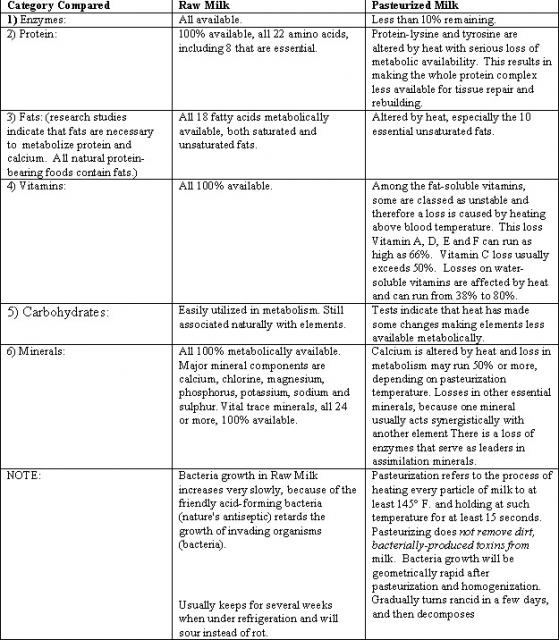
However pasteurisation also has other effects on the nutritional content
of the food. Please find attached the nutritional chart mapping out the
differences. The need to make milk safe to drink is of course an important
one, so lets be sure proper sanitisation methods are used in milk carrying
equipment and that animals remain healthy through proper farming. Then we
will be able to safely drink raw milk that carries with it all of these
wonderful nutrients that can build health and immunity. Pasteurised milk is
very much a damaged food, with much less nutritional value. Health in the
last 40 years in western culture has not improved, but got significantly
worse, despite all the precautions to protect us. The quality of food has
definitely detiorated, so the hosts (humans in this case) are not as
strong and resistant to infection. After all the pathogens that cause
these illnesses have been around a long time!
I do appreciate your time in reading this email and my thoughts. I am very
much in support of hygenic milk, but want to benefit from the higher
nutrition of raw milk compared to pasteurised. Why is it such a legal
challenge for many farmers to sell raw milk? Surely we should be given the
option as the consumer to choose for ourselves. Smokers are allowed to
choose to smoke and bring on serious illness and the NHS still picks up
the bill. The illness associated with raw milk is a drop in the ocean in
comparison.
I would very much appreciate a response. What is the chance of the laws
surrounding raw milk being eased?
regards
Ben Pratt
BSc Hons
Dear Mr Pratt
Thank you for your email of 21 November 2006. Please accept my apologies
for the delay in responding to you. Your email raises issues not just of
hygiene, but also of microbiological safety and nutrition. I am, therefore,
consulting with colleagues from Microbiological Safety Division and
Nutrition Division within the Agency. I hope to be able to send you a
fuller response shortly.
Please contact me if I can be of further assistance with this or any other
matter.
Ifzal Khan
Dairy Hygiene Branch
Primary Production Division
And the final reply: 05/02/2007
Dear Mr Pratt
Further to your email of 21 November 2006, and my initial email in response
of 2 January. I have now received the advice that I was waiting for.
There is strong support from consumers and producers of unpasteurised milk
for sales to continue. Indeed there are some who actively advocate
deregulation of the current marketing rules, so that raw drinking milk may
be sold more freely. On the other hand, there is equally strong opposition
to continued sales from public health professionals and organisations such
as the Haemolytic Uraemic Syndrome Help (HUSH). It is against this
background that we consider the best approach is to maintain the existing
regulatory requirements.
Colleagues in the Agency's Nutrtion Division have informed me that we are
unable to comment on any nutrient differences between raw and pasteurised
milk as we do not hold any information on this. The Agency's advice is to
consume milk and other dairy foods in moderation as part of a healthy
balanced diet, choosing lower fat varieties where possible. Milk and dairy
foods such as cheese, yoghurt and fromage frais are an important source of
calcium in the diet (needed for bone health) and are also a source of
protein and vitamins A, B12, and D.
The Agency's Microbiological Safety Division leads on breast milk issues.
They have advised me that breast milk is not sterile and micro-organisms
will be acquired from the skin and nipple as milk is expressed. The
Chinese study found a higher level of contamination which in part may have
reflected the Chinese tradition of not bathing for one month after
childbirth. In most studies in the literature the levels of bacterial
contamination tend to be low (102-103/ml) and variable although an
“acceptable” contamination level and potential for multiplication in
expressed breast milk has yet to be clearly defined.
Good hygiene is important in preventing contamination of breast milk with
harmful microorganisms and careful attention to cleaning and sterilisation
of equipment such as breast pumps and storage containers is emphasised in
most publications and websites providing advice and guidance in this area.
Breast milk is known to contain a number of protective factors including
specific antibody and anti-adhesion factors and a range of components with
antimicrobial activity. It is difficult to understand the rationale that
the presence of a pathogen is important for the functioning of these
mechanisms in the longer term. Pathogens such as Salmonella,
Campylobacter and VTEC O157 should not be present in breast milk, raw cows
milk or pasteurised milk. Even though breast milk carries protective
factors it is recognised that there are risks with prolonged storage and
donor breast milk is sometimes pooled such as in human milk banks where the
milk is pasteurised before use.
We would not advise the giving raw milk to vulnerable groups such as babies
or infants and pasteurised cows milk should not be given to infants under
12 months of age.
Please contact me if I can be of further assistance with this or any other
matter.
Ifzal Khan
Dairy Hygiene Branch
Primary Production Division
Summary: Here's a nutritional comparison: You decide!